Chapter 05 · How money really works

The trickle that never trickles

4 min
You are joining a course midway

This chapter builds on the ones before it. You can read it now, but it will not count towards your progress until the earlier chapters are done.

Block
# block 0001

You're a banker. Your vaults are overflowing with M0, your margins are razor-thin, and management wants volume. On your desk: two loan applications. One earns you almost nothing, but carries almost no risk. The other could fund the next industrial revolution. Or not. You've got 30 seconds. Welcome to the Cantillon Effect.

Margins are crushed, but the vaults are overflowing with M0. The commercial bank's survival equation is simple: do volume while taking on as little risk as possible.

Time to sort the pile: as a banker, here are your next two appointments.
# block 0002
# block 0003
Quiz

So, which profile would you rather lend to?

# block 0004

The bottom line: money goes to money

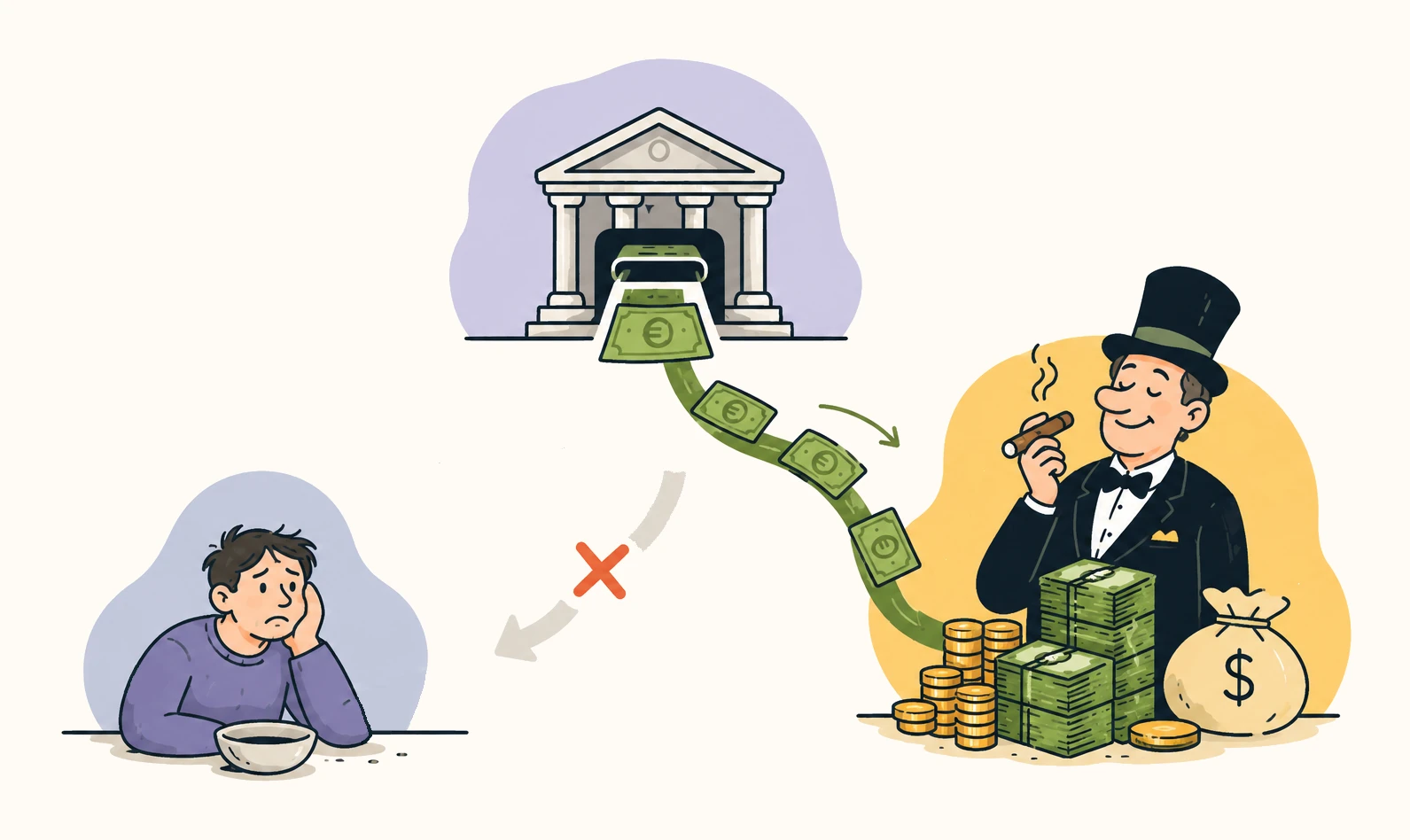
You've just understood the mechanics of the Cantillon Effect, named after the 18th-century Irish economist Richard Cantillon(opens in a new tab) : newly created money (M2) flows first toward assets, judged less risky, rather than into the real economy. The "Scrooges" get richer in their sleep: demand for assets climbs, and so do their portfolios. The "Geos" are left on the sidelines.

Cantillon Effect
The trickle-down of money: the monetary tap fills the “Scrooges’” pockets first, before any of it ever trickles down... all the way to our shopping cart
# block 0005
But when the Scrooges feel wealthy, they eventually start spending. More demand, same amount of goods, prices climb. And that's when it spills over into the shopping cart. Wait, did someone just say the word ?

© 2026 - Bitcoin.Decoded

Doodle icons: Streamline (CC BY 4.0)