Chapter 01 · The Bitcoin breakthrough

Bitcoin, under the hood

9 min
Block
# block 0001

Bitcoin is three things at once: software, a network, and a currency. Three simple words. And yet, explaining how these three pieces hold together, without any bank, any government, anyone in charge, is where most explanations fall apart. Let's try not to fall apart.

Explaining Bitcoin in a simple yet complete way isn't easy: it's a tricky object to approach because it touches on so many different topics.

Bitcoin is three things at once:

  1. A piece of software
  2. A network
  3. And a currency

Together, these pieces form the essence of Bitcoin: a public payment infrastructure.

This infrastructure changes the picture: it lets anyone, anywhere, at any time, send or receive value. Without discrimination. Without any trusted third party. Purely peer-to-peer, inside a decentralized network.

# block 0002

"OK, sounds nice, but how does it actually work?" you're probably asking.
And you're right to ask. That's exactly what you're about to see.

# block 0003

And the Bitcoin network is nothing more than a bunch of nodes connected to each other.

Node A
Node B
Node C
Node D
Node E
Node F
Bitcoin Network

There are several types of nodes:

  • Simple nodes (the ones you just saw).
  • And mining nodes (the ones you're about to discover).
# block 0004
# block 0005

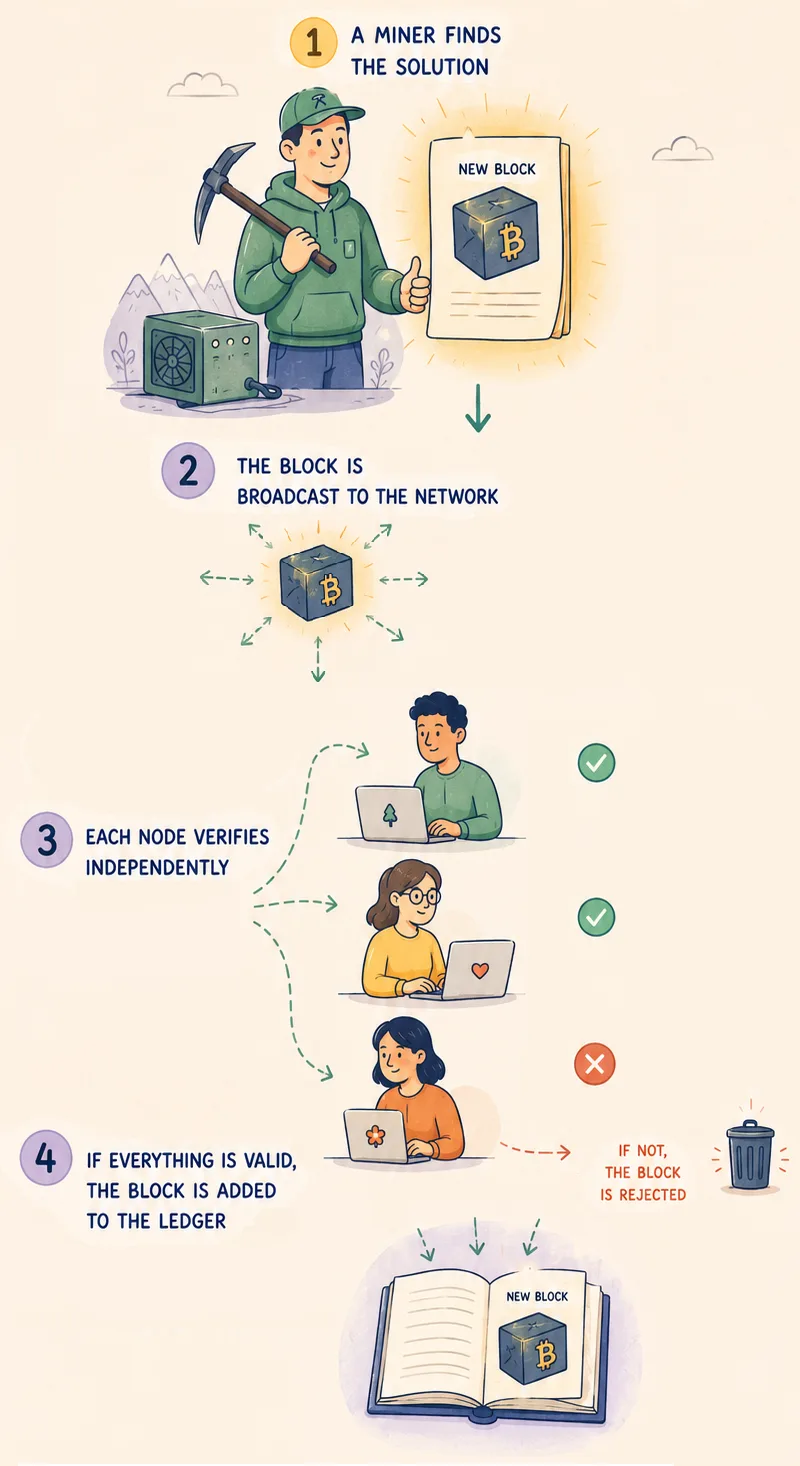
Once a miner finds the solution and proposes a new block, it gets broadcast to the entire network.

Simple nodes then step in: each one independently checks that the block follows every rule:

  • Are the transactions valid?
  • Was the calculation properly solved?
  • Was any rule broken?

If everything checks out, the node adds this new page to its own copy of the ledger. Otherwise, the block is plainly and simply rejected.

This collective, independent verification is what makes Bitcoin so robust: nobody trusts anyone, but everyone verifies everything.

# block 0006

To recap, here are the two players in the network:

Simple node
The rule keeper
Its role:
Store a complete copy of the blockchain and check that every transaction and every block follows the protocol's rules.
Its superpower:
Reject any invalid block, even from the most powerful miner on Earth.
Within reach of anyone:
A regular computer and an internet connection are all it takes to run one.
Mining node
The block builder
Its role:
Propose a new block full of transactions by being the first to solve that calculation.
Its superpower:
Create new bitcoins with every validated block, in an amount that gets cut in half roughly every four years, up to a total cap of 21 million.
What it takes:
Specialized computing hardware (ASIC) and cheap electricity to make it profitable.
# block 0007

There you have it. You now grasp the foundations of Bitcoin: a decentralized network where nodes keep the rules and miners secure the system in exchange for bitcoin.

No bank to validate the transactions. No government to run the network. No middleman to authorize your payment. Just code, electricity, and math.

But one crucial question still hangs in the air: why does all of this matter?
Why would humanity need a currency that nobody controls?

To understand it, we'll have to revisit the crises that shaped our era and discover what Bitcoin brings to the table.

© 2026 - Bitcoin.Decoded

Doodle icons: Streamline (CC BY 4.0)